
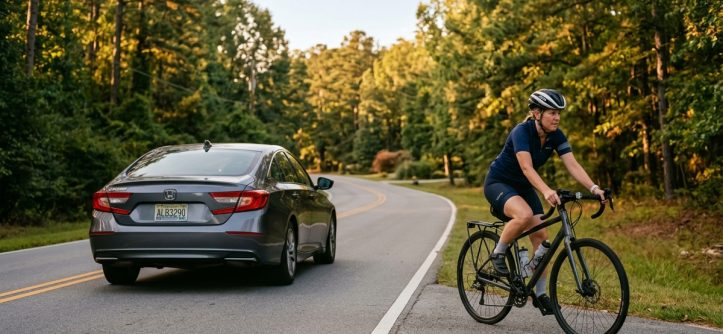
Alabama roads place motorists and cyclists close together, especially on streets without dedicated bike lanes. Because state traffic laws give people riding bicycles important roadway rights while also assigning them traffic duties, drivers cannot treat cyclists as unexpected obstacles with no place in traffic. Knowing the rules that commonly affect a bicycle accident can also clarify how fault may be evaluated after a serious collision.
Cyclists Have Roadway Rights Drivers Cannot Simply Ignore
Cyclists using Alabama roadways generally receive the rights and carry the duties that apply to vehicle drivers, except where bicycle-specific rules or the nature of a rule makes it inapplicable. That principle matters because a motorist cannot assume a person on a bicycle must automatically surrender the lane whenever a vehicle approaches.
Roadway position still affects bicycle accident claims because Alabama also places certain obligations on cyclists concerning where and how they ride. Evidence such as lane markings, photographs, video, and witness accounts may help establish whether both parties were following the rules before the bicycle crash rather than relying on assumptions about who belonged on the road.
Safe Passing Means Giving a Bicycle Real Room
Drivers overtaking traffic must pass at a safe distance and remain clear before returning to the right side of the roadway. Alabama law also defines a safe passing distance as at least three feet in specified circumstances involving a bicycle traveling within two feet of the roadway’s right shoulder.
Passing too closely can leave a cyclist almost no room to react to pavement defects, wind, debris, or a sudden vehicle movement. However, the legal analysis after a bike accident may involve more than measuring three feet because attorneys can examine roadway width, cyclist position, traffic conditions, passing speed, and whether the driver returned to the lane safely.
Left-Turning Drivers Must Watch for Cyclists Coming From the Opposite Direction
Alabama requires a driver making a left turn to yield to approaching traffic that is already in the intersection or close enough to present an immediate hazard. A cyclist traveling lawfully from the opposite direction can therefore become highly relevant when a driver turns across the bicycle’s path.
Intersection collisions often happen quickly because a bicycle may be less visually prominent than a larger vehicle even though it is approaching lawfully. Crash investigations can compare signal timing, sight distance, surveillance video, witness testimony, and vehicle movement to determine whether the turning driver had an opportunity to see and yield before the bicycle accident.
Turn Signals Should Give Cyclists Advance Warning
State law requires drivers to make turns or lateral movements only when they can do so with reasonable safety. Alabama also generally requires a turn signal to remain active during at least the final 100 feet before a turn, giving surrounding road users advance notice that the vehicle is about to change direction.
Sudden turns are especially dangerous when a cyclist is traveling beside or behind a vehicle near a driveway or intersection. Failure to signal can become useful evidence in bicycle accident cases, although the claim still needs to connect that failure with the collision and resulting injuries rather than treating the traffic violation as the entire case.
Posted Speed Limits Are Not the Only Speed Rule That Matters
Speed must remain reasonable and prudent for existing conditions, so simply driving below the posted limit does not automatically make a motorist’s speed appropriate. Crowded intersections, poor visibility, narrow streets, rain, construction, or cyclists traveling nearby can require additional care.
Investigators may look at vehicle data, skid marks, video footage, impact damage, and witness observations when speed becomes disputed after a bicycle crash. Slower reaction time or longer stopping distance can become important to bicycle accident claims if excessive speed prevented the driver from responding once the cyclist became visible.
Distracted Driving Can Become Important Evidence After a Bike Accident
Alabama law restricts distracted operation involving handheld wireless and stand-alone electronic devices under specified circumstances. Phone use can be particularly dangerous around cyclists because a brief loss of attention may cause a motorist to drift across a lane, overlook a bicycle at an intersection, or miss a changing traffic signal.
Digital records do not automatically prove that distraction caused a particular collision, but they may become part of a larger evidence picture. Phone activity, eyewitness observations, vehicle movement, dashboard footage, and statements from the driver can help attorneys determine whether distraction contributed to a bicycle accident and whether it supports a negligence argument.
Green Lights Still Require Drivers to Yield in Certain Situations
Traffic signals do not give a driver unlimited permission to move simply because the light is green. Alabama’s signal rules still require turning traffic to yield to other vehicles and pedestrians lawfully within the intersection or an adjacent crosswalk when applicable, while drivers facing red must stop before making a permitted turn.
Right-of-way disputes can become complicated when a bicycle crash happens during a signal change or turning movement. Timing records, traffic cameras, nearby surveillance systems, physical evidence, and witness statements may establish which direction had the signal and whether the motorist entered the cyclist’s path without sufficient clearance.
Traffic Violations Can Become Part of a Larger Liability Investigation
Breaking a traffic rule can provide meaningful evidence after a bicycle accident, but a successful injury claim generally requires more than identifying a citation. Legal responsibility also involves determining whether the driver’s conduct caused the collision and whether the bicycle accident produced the injuries and financial losses being claimed.
The Lackey Law Firm can help injured cyclists after a bike crash by investigating fault, preserving evidence, dealing with insurance companies, and documenting medical expenses, lost income, property damage, and other losses. Their attorneys can also address disputed liability, review available coverage, protect important deadlines, and pursue a fair resolution through settlement or litigation when needed.




Leave a Reply